


Faster. Smarter. Safer.

PS26/2 gives carriers a direct new reporting obligation, and gives everyone else in the distribution chain a clear signal of what is coming next. REG turns your third party register into a system you already run, not a project you build from scratch against a deadline.

In March 2026, the FCA published PS26/2, alongside two pieces of finalised guidance: FG26/4 on material third party reporting and FG26/3 on operational incident reporting. The rules come into force on 18 March 2027.

The FCA, the PRA and the Bank of England have built a single regime around this. You make one submission, and the FCA passes it on to the other regulators. Notifications go through FCA Connect. The annual register goes through FCA REGData.

Before this regime, oversight only captured material “outsourcing”. The new rules capture any material third party arrangement, whether or not it counts as outsourcing. Buying software, delegating underwriting, running third party analytics: all of it now sits inside the assessment.

This becomes your data collection and approval regime. The FCA may not sign off your arrangements, and may not respond to a notification at all, but the obligation still sits with you: hold the data, and produce it in the fixed format when asked.


What Counts as “Material”

An arrangement is material where its disruption or failure could cause intolerable harm to your clients, pose a risk to the UK financial system, or cast serious doubt on your ability to meet the threshold conditions, the Principles, or your operational resilience.

Who This Affects

It is a structured data set most firms do not currently hold in one place.

  • Direct obligation

    Carriers

    If you are an insurance carrier or a Lloyd's managing agent, PS26/2 gives you two new duties. Notify the FCA when you enter into, or significantly change, a material third party arrangement. Submit an annual register of every material arrangement you hold.
     
    The register runs to roughly 45 fields per arrangement, covering why it is material, when you last assessed it, whether it supports an important business service, your impact tolerances in hours, where the data sits, and the risk assessment behind it.

  • Confirm your scope

    MGAs and Brokers

    Not every regulated firm is directly affected, and it depends on how the FCA classifies you. Every regulated firm sits in one of three SM&CR tiers: Limited, Core or Enhanced scope. Enhanced scope firms, the largest and most complex in the market, are directly caught by these third party rules. MGAs and brokers sit in Core or Limited scope. Firms earning roughly £35 million a year from regulated business are likely to fall into Enhanced scope.
     
    Do not assume either way. Check your own scope rather than treating any part of this as settled, and if you are not directly in scope, change the conversation you are having internally: not "you must do this" but "your carriers will be asking you for this." You are, in effect, about to become someone else's audit evidence.

  • Affects everyone

    Every Firm in the Chain

    Even where the register itself does not apply to you directly, its effects reach further than the firms who file it. Expect a supply chain ranking exercise that assesses how closely a third party sits to the carrier at the top of the chain.
     
    The operational incident reporting rules published alongside PS26/2 reach every firm in the insurance market, not just those who hold the register.

Now live in REG Network

Your PS26/2 register, managed in REG

A configurable materiality assessment, a register built to the regulators’ template and a pre-filled export for the FCA, so the register is a process you run rather than a spreadsheet you build.

See how it works

  1. Assess materialityYour questions, automatic scoring
  2. Build the registerAround 45 data points per provider, gaps shown
  3. Export for the FCAA pre-filled file in the FCA template

A Register That Builds Itself as You Work

A Register That Builds Itself as You Work

Most firms do not lack the information PS26/2 asks for. They lack a place where it already lives together: dated, attributed and ready to produce. REG Network holds your counterparties, their risk assessments and the documents behind them in one system, so producing the annual register is a matter of pulling a report, not building one from scratch under deadline pressure.

That is the shift REG is built around: evidence generated as a by-product of the work your team is already doing, not a separate exercise it runs once a year to keep the regulator happy. A third party register that you don’t have to build from scratch.

How REG Helps You Get Ready

  • A Single Source of Truth

    Your register is only as good as the record behind it, and REG already sits across your distribution chain, tracking 38,000+ counterparties across 180 countries. Every material arrangement, its risk assessment and its history sit in one place, not spread across spreadsheets and inboxes.
  • Materiality and Risk Tiering, Evidenced

    REG Risk 365 handles risk tiering across your counterparty population. The materiality assessment itself runs in REG Network, scored against criteria you set, with the reasons recorded against each outcome.
  • Due Diligence, Dated as You Go

    Continuous due diligence with dates attached as it happens, not a Q4 panic to reconstruct a year of assessments from memory when the submission window opens.
  • Visibility Down the Chain

    Through REG Exchanges, you get visibility of the full product chain, so the supply chain ranking exercise starts from a record you already hold rather than one you build from scratch. Partners answer and forward requests as free users, so you can reach providers beyond the ones you contract with.
  • Work Through Your Own Materiality Assessment

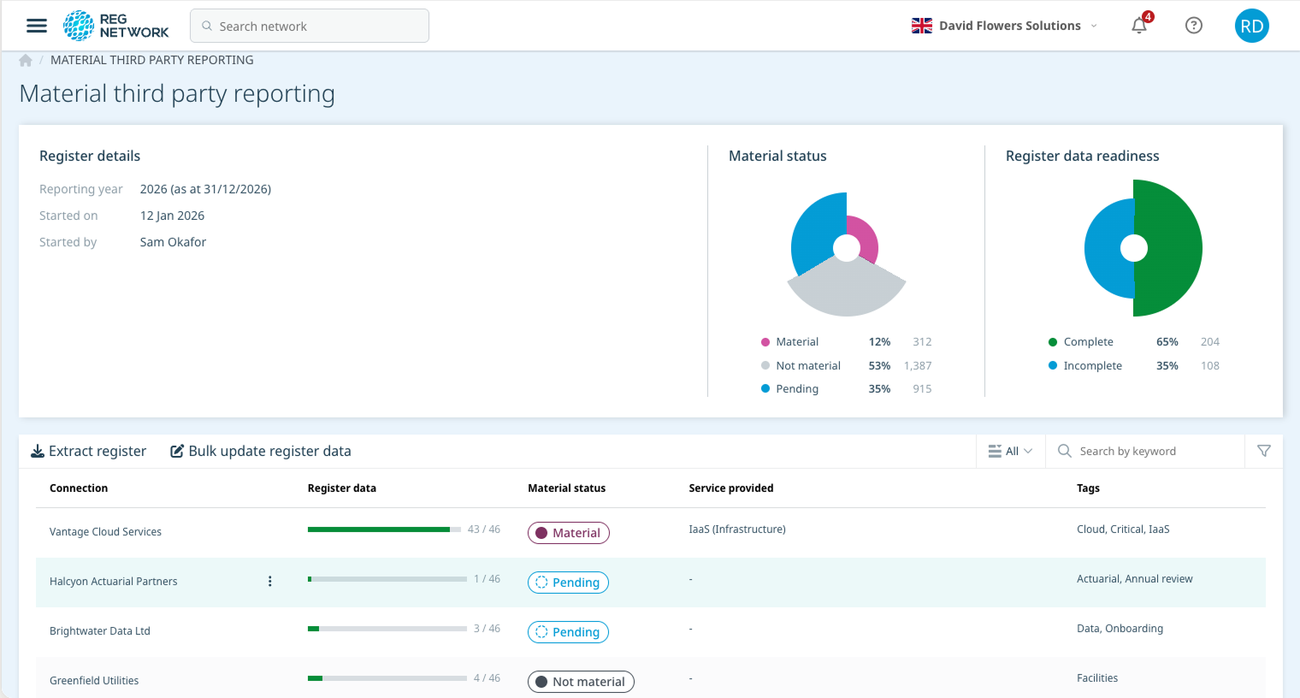
    Work through the same questions the FCA asks: potential client harm, risk to the UK financial system, and doubt cast on your threshold conditions, the Principles or your operational resilience. The assessment runs in REG Network on a template you can change to fit your own methodology, and each provider comes out as material, not material or pending, with the reasoning kept against it. The decision on each arrangement stays with your team.
REG Network material third party reporting screen, showing register details, material status and register data readiness for each connection

How REG Turns Your Day-to-Day Into Your Evidence

Every assessment REG runs, every document REG Exchanges captures, and every change REG Network monitors becomes part of the same record, timestamped and attributed as it happens.

REG does not treat evidencing as a report you write once a year. Materiality assessments, risk tiering, document sign-off and counterparty monitoring all happen inside the same system, so the data and the process behind every decision are already connected. When you need to prove that an arrangement was assessed correctly, or show when something changed and who reviewed it, the answer already exists inside REG. It does not need to be reconstructed.

Book a solutions call
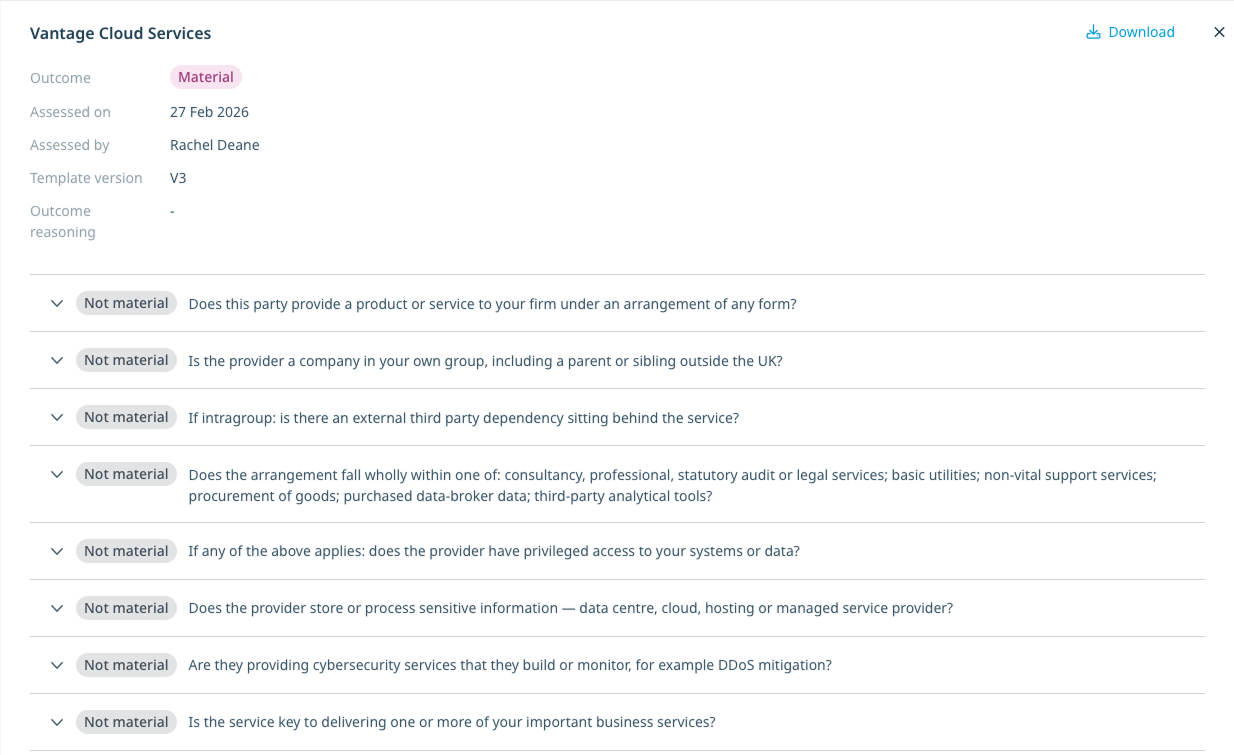
REG Network materiality assessment for a provider marked material, showing who assessed it, the date, the template version and the outcome of each question

Every materiality decision, with the reasons behind it

Each provider’s assessment ends in an outcome, and REG keeps the working that led to it.

Open a provider in REG Network and you see the outcome, who assessed it, the date and the version of your template they used. Below that is the answer to every question, with any notes your team added. When the board or the FCA asks why a provider is on the register (or why it isn’t), you can download the assessment and show them.

See the PS26/2 register

Frequently Asked Questions

Does REG submit our PS26/2 register to the FCA for us?

No. REG is not a law firm or a compliance consultancy, and it does not file on your behalf. REG gives you the structured record and the evidence trail so your team can produce the register in the format the FCA asks for, whoever in your organisation is responsible for submitting it.

How do I know if my firm is Enhanced scope?

REG cannot make that determination for you. It depends on your own SM&CR classification, and it is worth confirming with your compliance function or adviser rather than assuming either way. What REG can do is make sure your record is ready whichever way that answer lands.

We are an MGA or broker and think we are out of scope. Does this affect us at all?

Possibly not directly, but your carriers are the ones filing the register, and they will increasingly expect evidence of your own third party oversight to back up what they submit about you. Being ready to produce that evidence is worth doing even without a filing obligation of your own.

What counts as a "material" third party arrangement?

One where disruption or failure could cause intolerable harm to your clients, pose a risk to the UK financial system, or cast serious doubt on your ability to meet the threshold conditions, the Principles, or your operational resilience. It is not limited to outsourcing arrangements: software, delegated underwriting and third party analytics can all qualify.

Does REG replace our compliance team's judgement on materiality?

No. REG gives you the data, the history and the evidence trail to support that judgement. The assessment of what counts as material for your firm remains yours to make, and REG does not guarantee compliance or audit outcomes on your behalf.

When do I need to be ready by?

The rules come into force on 18 March 2027. The annual register needs to be accurate as at 31 December each year and submitted within a 90 day window once it opens, alongside notifications of new arrangements and significant changes as they happen. Firms in scope should be building the record well before that window opens, not once it has.

Get your third party register ready before the FCA asks for it.

PS26/2 was published in 2026, and firms need their register evidenced and ready to produce by 18 March 2027. Building that record takes time, so the earlier you start, the less you are doing against the clock.