RegTech in Insurance: How Compliance Teams Keep Up with Regulatory Change
How regtech helps insurers, MGAs and brokers automate due diligence, monitor counterparties continuously and stay audit-ready as regulatory demands grow.
Blogs
Most counterparty risk platforms demo well. You see a clean dashboard, a red-amber-green rating, an alert firing at exactly the right moment. You find out whether any of it holds up about six months after go-live, when your compliance team is working through four hundred partners in renewal season and the ratings stop matching what the team already knows.
Buying the wrong platform costs more than the licence fee. You inherit a second set of records that disagrees with your first set, and an audit trail that stops at whatever the vendor decided to log.
The regulatory backdrop has hardened while insurers have been making these decisions. Firms had to be operating within their impact tolerances for important business services by 31 March 2025 under the FCA’s operational resilience rules. HM Treasury designated the first four critical third parties on 10 July 2026, which turned the regime introduced in PS24/16 from a policy into something with named firms attached. Both point the same way: your oversight of the people you depend on needs to be continuous and evidenced, not annual and anecdotal.
Below is the framework we would use if we were sitting on your side of the table.
A platform that ships with a fixed risk model is telling you that its view of a broker in Leeds should match its view of a coverholder in Dublin. Yours probably does not.
Ask whether you can set your own thresholds, weightings and rating bands, and whether you can run more than one framework at once. A firm writing delegated authority business usually needs a different appetite for coverholders than for suppliers, and the platform should carry both without a change request.
Watch for the version of configurability that means “we will build it for you”. That is a services engagement wearing a product badge, and you will pay for it again the next time your appetite changes.
Point-in-time due diligence tells you a counterparty was sound on the day someone checked. Most of the risk arrives between checks: a director resigns, a permission lapses, a filing goes overdue, a sanction lands.
The question to press on is what triggers a re-look. A platform that only re-screens on an annual review date has automated your calendar, not your oversight. You want changes at the counterparty to drive the alert, with a threshold you control so the team is not buried in notifications about address corrections.
Vendors like to talk about the number of sources they cover. The number matters less than knowing which ones, how often each refreshes, and what happens when a source goes down.
Ask for the list. Companies House, the FCA Register, sanctions and PEP data, credit and financial health, adverse media, and cyber posture all behave differently and update at different speeds. A platform that will not tell you where a red flag came from leaves you unable to defend the decision you made on the back of it.
Compliance teams rarely lack data. They lack one version of it. The due diligence pack sits in a shared drive, the TOBA sits with legal, the risk rating sits in a spreadsheet, and the email trail that explains the 2024 exception sits in somebody’s inbox.
A platform earns its place by holding the counterparty record and the reasoning together. You should be able to open a partner and see what the rating is now, what it was eighteen months ago, what moved it, and who signed it off.
Test this against a real request rather than a hypothetical. Pick a counterparty you have had a difficult conversation about and ask the vendor to show you the report they would hand a supervisor.
You are looking for the decision trail, not the dashboard. The rating on screen matters far less than the ability to show why your firm reached it, on what information, and on whose authority. Screenshots of a RAG chart do not survive contact with a skilled person review.
Plenty of third-party risk tools were built for supplier management in banking and retrofitted for insurance. They handle a vendor contract well and fall over on a binder.
Check how the platform models the things specific to this market: coverholders and their permissions, appointed representatives and principal firm responsibility, TOBAs, chains where you delegate to a firm that delegates onward. If you have to describe an MGA as a “supplier” to get it into the system, the fit is wrong.
The hidden cost of counterparty oversight is chasing. Someone on your team emails a broker for an updated certificate, waits, emails again, and repeats that across the book twice a year.
Ask what the counterparty’s side looks like. Where partners maintain their own profile and that data reaches everyone who needs it, most of the chasing stops. Where the platform gives your team a tidier place to record the chasing, your headcount problem stays where it is.
A slick demo can make almost any platform look compelling. The real test is how quickly it can be integrated and delivering value without turning implementation into a consultancy project. Time-to-value should be a core assessment criterion for insurers because, ultimately, BAU doesn’t stop for implementation.
Two years in, you will want to change a threshold, add a field, export the lot, or move. Establish now whether your team can do the first three without raising a ticket, and what the fourth costs.
Get the data exit terms in writing before you sign. Your counterparty records and their history belong to you, and the contract should say so in a way that does not depend on goodwill.
A demo environment with invented counterparties and no offer to load some of yours. A refusal to name data sources. Configuration that only the vendor can perform. Pricing that scales on counterparty count with no cap, in a market where your network grows every year. A roadmap presented as a substitute for current function.
REG Risk 365 was built for this market rather than adapted to it, on top of the REG Network that insurers, brokers and MGAs already use to share and maintain their own data. Firms set their own risk appetite and scoring, monitor counterparties continuously across REG’s data sources, and keep the audit trail of how each rating changed in one place.
The honest answer is that the framework above should be used on us as well. If a platform will not show you the decision trail behind a rating, ours included, keep looking.
Configurable risk appetite and scoring rather than a fixed model, continuous monitoring driven by changes at the counterparty, named and dated data sources, a single counterparty record holding both the rating and the reasoning behind it, reporting a supervisor would accept, and a data model that understands coverholders, appointed representatives and TOBAs rather than generic suppliers.
GRC software covers the whole risk and control estate across a firm, including internal risks. A counterparty risk platform concentrates on the firms you do business with, holding the due diligence, monitoring and rating for each one. Larger insurers often run both and feed counterparty ratings into the wider GRC picture.
Refresh on change rather than on a fixed cycle. Annual reviews still have a place for the full file, but a platform should re-rate a counterparty when something moves at that counterparty, such as a permission lapsing, a director change, an overdue filing or a sanctions match.
It depends on the size of the network rather than the size of the firm. An MGA with twenty counterparties can hold the position in a spreadsheet if the governance around it is disciplined. Past roughly fifty, the chasing and version control usually cost more than the software.
The regime gives UK regulators direct oversight of a small number of designated providers, with the first four designated in July 2026. It does not transfer responsibility away from your firm. You still have to evidence your own oversight of the third parties you depend on, whether or not they are designated.

How regtech helps insurers, MGAs and brokers automate due diligence, monitor counterparties continuously and stay audit-ready as regulatory demands grow.
As regulatory pressure intensifies and third-party ecosystems grow more complex, insurers can no longer afford fragmented approaches to compliance and counterparty risk. Forward-looking organisations are embedding integrated GRC frameworks and leveraging technology to gain continuous visibility, standardise decision-making and proactively manage emerging risks. This guide explores how a more connected, intelligence-led approach, supported by solutions like REG Risk 365, enables firms to move beyond reactive compliance and build resilient, scalable risk management capabilities.
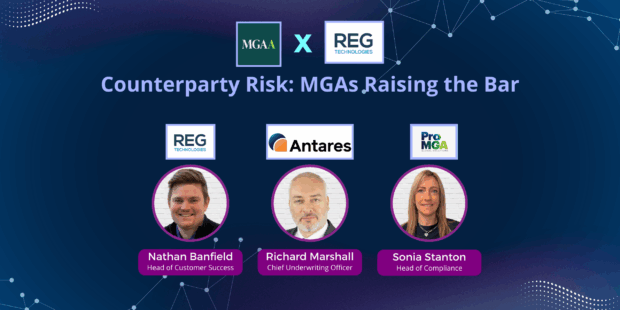
Supplier risk controls keep the capacity providers, brokers, coverholders and service providers an MGA relies on within its risk appetite. See the controls that matter, from onboarding checks to continuous monitoring, and watch Nathan Banfield, Sonia Stanton and Richard Marshall discuss how MGAs are raising the bar on counterparty risk.
The Managing General Agents’ Association (MGAA) has welcomed the launch of REG Risk 365 by REG Technologies, a new module within the REG Network designed to strengthen counterparty governance across the distribution chain...
In a competitive insurance market, the ability to find, assess, and onboard the right partners can make all the difference. Yet too often, the process is slow, resource-intensive, and leaves room for risk. That’s why REG launched Business Profile and Smart Search – two powerful features that take the guesswork out of partner discovery and make onboarding faster, safer, and more efficient. Watch our recent webinar on demand...
In regulated industries like insurance and financial services, expanding your network starts with one critical question: How do you find the right trading partner - one who aligns with your values, regulatory requirements, and strategic goals? Many teams face this challenge daily, juggling fragmented information while trying to make confident decisions...
Insurance distribution chains depend on many partners. Each one needs checking when the relationship starts and again as it develops. A single MGA may work with dozens of brokers, coverholders and service providers, and each relationship carries its own documents, checks and review dates.
The insurance sector is facing relentless regulatory change, meaning effective counterparty risk management has never been more critical. Recent research reveals that 74% of industry leaders have experienced a notable increase in regulatory demands over the past year. From MGAs to insurers and brokers, the pressure to demonstrate robust governance, risk, and compliance (GRC) practices is intensifying. Key areas of focus include fair value, consumer duty, anti-money laundering (AML), and the increasingly vital consideration of Environmental, Social, and Governance (ESG) factors...
The life insurance industry is grappling with increasing regulatory demands and outdated manual processes, both of which make effective counterparty due diligence and oversight hard to uphold. To meet the regulatory requirements from the FCA and PRA, firms operating in the life insurance sector must ensure their operations and counterparty due diligence is constantly a key compliance priority. Managing these challenges with traditional outdated, often manual approaches, is no longer sufficient, and the growing need for sophisticated compliance systems is proving essential to meet the demands of regulatory obligations and enhance compliance...
At REG, we are on a mission to build the largest and most trusted B2B network in the insurance industry. We understand that businesses need to connect quickly and confidently when forging new relationships, without the burden of regulatory obligations slowing them down. That’s why we created REG Verified — The Trusted Status for Businesses...
"*" indicates required fields
By signing up for newsletter updates you agree to our privacy policy.